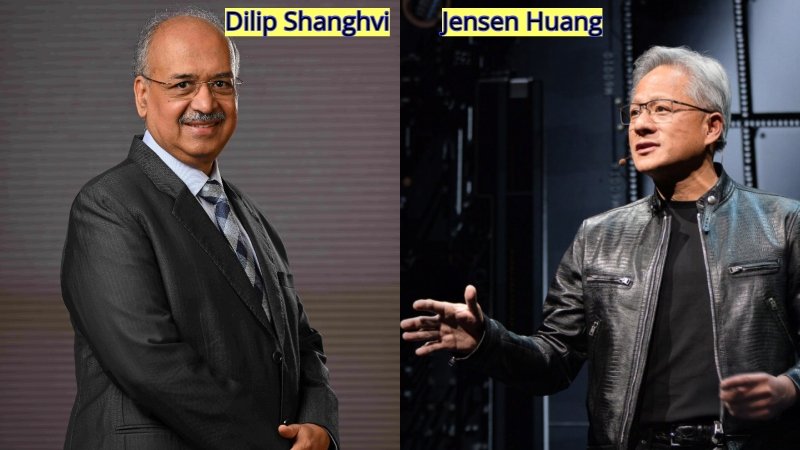
Dilip Shanghvi and Jensen Huang built their fortunes in very different industries. Shanghvi developed Sun Pharmaceutical Industries into a major global healthcare company, while Huang helped turn NVIDIA from a graphics-chip business into a leading force in accelerated computing and artificial intelligence. Although their businesses serve different markets, both entrepreneurs built their companies over several decades and remained closely involved in their long-term direction.
Their journeys offer an interesting comparison. Shanghvi focused on pharmaceuticals, specialty medicines, acquisitions and international expansion. Meanwhile, Huang built his career around semiconductors, graphics processing and the growing demand for powerful computing. Their stories show that successful entrepreneurship can take very different forms when leaders combine specialized knowledge with a long-term vision.
Who are Dilip Shanghvi and Jensen Huang?
Dilip Shanghvi is the founder and Executive Chairman of Sun Pharmaceutical Industries. Sun Pharma’s current board profile identifies him as Executive Chairman and notes his role in the company’s long-term development. The company has grown into a major international pharmaceutical business with operations across multiple markets.
Jensen Huang is the founder, President and CEO of NVIDIA. He established the company in 1993 and has led it from the beginning. NVIDIA says its invention of the GPU in 1999 helped reshape computer graphics and eventually contributed to the growth of modern AI.
| Detail | Dilip Shanghvi | Jensen Huang |
|---|---|---|
| Main industry | Pharmaceuticals | Semiconductors and computing |
| Major company | Sun Pharmaceutical Industries | NVIDIA |
| Company founded | 1983 | 1993 |
| Current role | Executive Chairman | President and CEO |
| Major area of influence | Healthcare and medicines | Accelerated computing and AI |
The comparison becomes more interesting when we look at how each entrepreneur built his company and adapted to changes within his industry.
Dilip Shanghvi’s early career and the rise of sun pharma
Shanghvi entered the pharmaceutical business with a relatively focused strategy. Forbes reports that he borrowed $200 from his father and founded Sun Pharmaceutical Industries in 1983 to produce psychiatric medicines.
From that starting point, he gradually expanded the business. Instead of trying to compete everywhere at once, Sun Pharma developed expertise in specialized areas and used acquisitions to broaden its portfolio and international reach.
Over the years, that strategy helped the company become one of India’s most important pharmaceutical businesses. A major example came with Sun Pharma’s acquisition of Ranbaxy Laboratories for $4 billion. The deal significantly increased the company’s scale and international presence.
More recently, Sun Pharma continued to strengthen its specialty-drug portfolio. The company acquired U.S.-based Checkpoint Therapeutics in 2025 for $355 million, adding an FDA-approved skin-cancer treatment to its business.
Today, Shanghvi remains Executive Chairman. He moved away from the Managing Director position in 2025 as Sun Pharma began a broader leadership transition, but he continues to influence the company’s strategic direction.
Jensen Huang’s journey from engineering to NVIDIA
Huang followed a more technical path. NVIDIA’s official biography says he earned a bachelor’s degree in electrical engineering from Oregon State University and a master’s degree in electrical engineering from Stanford University. Before founding NVIDIA, he worked at LSI Logic and Advanced Micro Devices.
Huang and his co-founders launched NVIDIA in 1993 with a focus on graphics technology. At first, the company became closely associated with computer graphics and gaming. However, its technology eventually found applications far beyond those original markets.
In 1999, NVIDIA introduced the GPU. The company describes that development as a major turning point because GPUs later became important for accelerated computing and artificial intelligence.
As AI workloads became more demanding, NVIDIA’s processors became increasingly valuable for training and running advanced models. Consequently, the company moved from being primarily known for graphics hardware to becoming a central supplier of AI computing infrastructure.
Huang has remained NVIDIA’s President and CEO throughout that transformation. His continued leadership gives him an unusual connection to the company’s evolution from its early graphics business to its current position in AI and accelerated computing.
How their companies built global influence
The two companies followed different growth paths because their industries require different strengths.
Sun Pharma operates in healthcare, where pharmaceutical research, manufacturing, regulation, product development and international distribution all matter. Shanghvi’s strategy combined specialized medicines with acquisitions and global expansion.
NVIDIA, by contrast, operates in the semiconductor and computing industry. Its growth depends heavily on technological innovation, hardware performance, software ecosystems and demand for computing power.
Nevertheless, both businesses share an important characteristic: they developed specialized capabilities and kept investing in them for decades.
For Sun Pharma, that focus created a large pharmaceutical portfolio and an international business. For NVIDIA, it created a computing platform that became increasingly important as AI expanded.
In other words, neither company relied on one short-lived trend. Each founder positioned the business to benefit from changes within its own industry.
Their leadership styles
Shanghvi’s leadership reflects the demands of a long-term pharmaceutical business. He spent decades expanding Sun Pharma and making strategic decisions around products, acquisitions and international markets. His current position as Executive Chairman allows him to remain involved in the company’s broader direction even after stepping away from the Managing Director role.
Huang’s leadership has remained closely connected to technology and product strategy. He has guided NVIDIA through several major changes, from graphics processing to high-performance computing and then to AI infrastructure.
At the same time, both leaders demonstrate the value of staying close to a company’s core strengths. Shanghvi built around pharmaceutical expertise, while Huang built around accelerated computing.
Their leadership styles differ, but their long-term commitment to their businesses creates one of the strongest similarities between their careers.
Dilip Shanghvi and Jensen Huang net worth
Their personal fortunes have reached very different levels, although both men rank among the world’s wealthiest entrepreneurs.
Forbes’ real-time profile listed Dilip Shanghvi at approximately $26.5 billion on September 9, 2026. Forbes identifies pharmaceuticals as his source of wealth and lists him among the world’s richest people.
For Jensen Huang, Forbes’ real-time profile listed approximately $195.4 billion on September 8, 2026. Huang’s fortune largely reflects his ownership stake in NVIDIA and the company’s enormous market value.
However, these numbers can change quickly. Public-company share prices affect billionaire estimates, so a net-worth figure should always include a date rather than appear as a permanent fact.
The difference in their fortunes also reflects the extraordinary rise in NVIDIA’s valuation during the AI boom. Meanwhile, Shanghvi’s wealth remains closely tied to the long-term performance of Sun Pharma.
Are Dilip Shanghvi and Jensen Huang connected?
There is no established public evidence that Shanghvi and Huang are business partners, relatives or founders of a joint venture.
Their names make more sense together as a business comparison. Shanghvi built his reputation in pharmaceuticals, while Huang built his in computing and AI.
Therefore, the interesting question is not whether they have a direct relationship. Instead, it is how two founders built influential companies in industries with completely different challenges.
That distinction also prevents a common mistake in biography content: assuming that two people have a personal or professional connection simply because search results place their names together.
What their careers have in common?
Despite the differences, their careers share several important characteristics.
First, both built companies over decades. Shanghvi founded Sun Pharma in 1983, while Huang co-founded NVIDIA in 1993. Neither entrepreneur depended on a quick path to success.
Second, both developed businesses around specialized expertise. Sun Pharma relies on pharmaceutical knowledge and healthcare capabilities. NVIDIA relies on semiconductor engineering, computing architecture and software.
Third, both adapted when their industries changed. Sun Pharma expanded into new pharmaceutical markets and strengthened its specialty portfolio. Meanwhile, NVIDIA expanded from graphics into accelerated computing and AI.
Finally, both founders remained influential long after their companies became large global organizations. Shanghvi continues as Executive Chairman, while Huang remains NVIDIA’s President and CEO.
What makes their success different?
The biggest difference lies in the type of value their companies create.
Shanghvi built a business around medicines and healthcare. His company’s success depends on developing, manufacturing and selling pharmaceutical products while navigating complex regulations and global markets.
Huang built a technology company around computing. NVIDIA’s growth accelerated as businesses and researchers demanded more processing power for graphics, high-performance computing and AI.
As a result, their careers represent two different forms of entrepreneurship.
Shanghvi demonstrates how strategic expansion can build a global healthcare company over time. Huang demonstrates how sustained technological innovation can position a company at the center of a major technological shift.
Neither story needs to be reduced to a simple wealth comparison. The more useful lesson comes from understanding how each entrepreneur created value within his own industry.
Where they stand in 2026
Shanghvi remains Executive Chairman of Sun Pharma in 2026. His role now places greater emphasis on strategic direction as the company continues to develop its specialty and innovative-medicine business.
Huang, meanwhile, continues to lead NVIDIA as President and CEO. The company’s current trajectory remains closely connected to the expansion of AI and accelerated computing. NVIDIA’s own biography describes the company as a major force behind the platform shift toward accelerated computing and generative AI.
Their current positions also show two different approaches to succession. Shanghvi has begun a formal transition in executive responsibilities, while Huang continues to lead NVIDIA’s daily operations more than three decades after its founding.
Conclusion
Dilip Shanghvi and Jensen Huang built remarkable businesses in completely different fields. Shanghvi developed Sun Pharma through pharmaceutical specialization, acquisitions and international expansion. Huang guided NVIDIA from its early graphics focus toward accelerated computing and artificial intelligence.
Their fortunes are also very different, but money alone does not explain their significance. Their careers demonstrate the value of developing deep expertise, thinking long term and adapting when an industry changes.
Most importantly, both entrepreneurs stayed committed to their companies for decades. Shanghvi continues to shape Sun Pharma as Executive Chairman, while Huang remains at the helm of NVIDIA. Their stories therefore offer two distinct examples of how focused leadership can create lasting influence in global business.
For another look at two influential figures from different fields, explore our article on Roger Federer and Conor McGregor and their careers, achievements, and global influence.