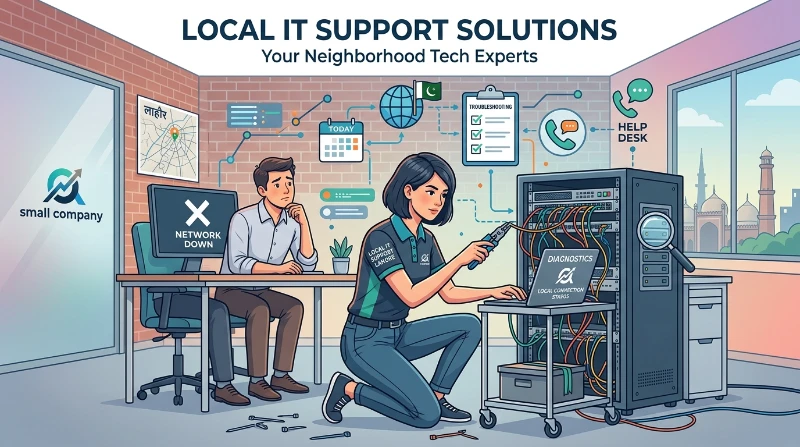
Local IT Support vs. Outsourced Help Desks: Which Is Right for Your Business?
The question “local or outsourced?” sounds like a choice between two kinds of support. In practice it bundles several separate decisions together: where the people sit, who employs them, how much they know about your business, and who is accountable when a problem is bigger than a single ticket. Pulling those apart is the quickest way to find out what a business actually needs.
Both models can work well, and both can fail. Quality varies far more by provider than by geography, so the useful comparison is not which label sounds better. It is which model fits the way a particular business operates.
The Label Hides What Actually Matters
“Local IT support” generally means technicians based nearby who can show up when something physical needs attention. An “outsourced help desk” generally means a remote team, often serving many clients from a central location, that answers tickets by phone, chat, and email. Those descriptions overlap more than they sound. Plenty of businesses choose outsourced IT services in Calgary or elsewhere precisely because the provider is nearby, which shows that “outsourced” says little about distance.
What matters more is how support is structured behind the label. Does the person who answers have access to documentation about the environment, or are they starting from scratch each time? Does someone own the whole picture between tickets, or does each request disappear once it is closed? A nearby provider with no documentation can be less helpful than a remote team with excellent records, and the reverse is equally true.
Where Local Support Earns Its Place
Local support has clear advantages in a few situations:
- Physical work. Cabling, hardware swaps, office moves, and network installations all need someone in the room.
- Business context. Technicians who see the office, meet the staff, and understand how the work flows tend to build knowledge that no ticket history captures.
- Accountability. A provider whose people can be at the door in an hour is easier to hold to commitments.
- Contract or regulatory preferences. Some businesses prefer, or are required by clients, to keep access to their systems with staff in a specific jurisdiction.
These strengths matter most for businesses with a single site or several sites, a lot of on-premises equipment, or staff who depend on in-person help.
Where an Outsourced Help Desk Is the Better Fit
An outsourced help desk is often the stronger choice in other situations:
- Round-the-clock coverage. A larger remote team can staff nights and weekends in a way a small local office cannot.
- Scale and specialization. A central team can include specialists in areas such as identity, cloud platforms, or particular business applications.
- Remote-first organizations. A company with no central office and a distributed workforce gains little from technicians who live nearby.
- Simple, high-volume needs. Password resets, software questions, and routine requests can be handled efficiently by a well-run remote desk.
These strengths matter most for cloud-based businesses, fast-growing teams, and companies whose problems are mostly digital rather than physical.
Side by Side
| Factor | Local-First Support | Outsourced Help Desk |
| Hands-on work | Strong, technicians can be on-site | Limited, usually needs a separate arrangement |
| After-hours coverage | Depends on staffing size | Often broad, with larger teams |
| Knowledge of your business | Builds through direct contact | Depends on documentation quality |
| Specialist depth | Varies, smaller teams | Often deeper, larger pool |
| Best for | Physical offices, equipment-heavy sites | Remote teams, digital-first operations |
No row decides the question alone. The right choice usually becomes clear when a business ranks which of these rows matter most to its day-to-day operations.
Cost comparisons deserve the same care. A monthly fee tells only part of the story, because what it includes differs widely. A lower-priced remote desk may bill separately for every on-site visit or project, while a local provider’s fee may include some hands-on time but cover fewer after-hours calls. Comparing like with like means asking exactly what is included, how on-site work is billed, and what happens to the price when staff numbers or locations change.
The Hybrid Most Mid-Sized Businesses End Up With
Many organizations stop treating the question as either-or. A common arrangement uses a remote help desk for first-line questions and local engineers for on-site work, planning, and anything complicated. Another pairs an internal IT person with an outside provider that fills the gaps, such as monitoring, after-hours coverage, or specialist projects. This co-managed approach keeps institutional knowledge in-house while adding capacity the internal team cannot cover alone.
The hybrid works only if responsibilities are clear. Someone has to own escalation, documentation, and the overall plan, otherwise requests fall between the two sides.
Questions That Cut Through the Pitch
Whichever model a business leans toward, a handful of questions reveal the quality behind it:
- When someone calls, does the technician see documentation and ticket history for the environment?
- How are problems escalated, and how quickly does a complex issue reach someone senior?
- Is there a named contact who understands the business, or does each call reach a different person?
- What happens outside business hours, and what does that coverage actually include?
- If the relationship ends, who owns the documentation, passwords, and configuration records?
The last question tends to be the most revealing. A provider confident in its service has no reason to make leaving difficult.
Choose by Need, Not by Label
A business that mostly needs fast answers for digital questions may be well served by a strong remote desk. A business with equipment, multiple offices, or staff who need someone in the room will likely want people nearby. Many will want some of both. The decision gets easier once the question changes from which model sounds better to where the business actually feels friction today, and which arrangement removes it.